• Skip to main content
  • Skip to footer

Elite Accounting

Chartered Accountant | Small Business Accountants in New Zealand

09 393 7025

  • Services
    • Accounting and Tax
    • Audit and assurance
    • Advisory
    • Bookkeeping & Payroll
    • Small & Medium Business
    • Tax Review & Audit
    • Financial Supervisor
    • Custom Services
  • Packages
  • Industries
  • Resources
    • Blog
    • Free Xero
    • Resources
  • About Us
  • Contact Us

Avoiding IRD Penalties: A Guide to Financial Audits in New Zealand

accountant nz

Apr 13 2026

You’re wrapping up your week. Numbers are “mostly” updated. GST is filed. Things seem under control.

Then a message lands from the Inland Revenue Department.

Nothing dramatic. Just a request to review your records.

Still, something shifts.

You start replaying decisions in your head.

“Did I claim that correctly?”

“Was that expense business-related?”

“Are my records clean enough?”

This is the part everyone ignores. Not the audit itself. The doubt before it.

Most businesses don’t fail audits because of major issues. They struggle because of small gaps. Small delays. Small assumptions.

And over time, those small things build patterns.

That’s what audits pick up, and the importance of a tax accountant is felt!

What an IRD Audit Really Means (Without the Fear)

Let’s strip this back.

An audit is not an accusation. It’s a verification process.

The IRD checks whether what you reported matches your actual financial activity. That includes:

  • Income and revenue
  • Business expenses
  • GST filings
  • Payroll and PAYE records

Sometimes it’s random. Sometimes it’s triggered by irregularities. But here’s the key point.

An audit is not about perfection. It’s about consistency and accuracy. If your records tell a clear, logical story, the process is usually smooth. If they don’t, that’s when things slow down.

Where Most Businesses Start Losing Control

No one plans to get into trouble. It happens gradually. You get busy. Priorities shift. Financial admin gets pushed to “later.” Here’s how it typically unfolds:

  • Week 1: You skip updating records
  • Week 3: You estimate a few figures
  • Month-end: You rush through GST
  • Quarter-end: You rely on memory

Nothing feels critical at the time. But now your data isn’t fully accurate. And once accuracy slips, confidence goes with it. That’s when stress starts to build.

Common Mistakes vs Real Business Impact

Let’s look at what actually happens behind the scenes.

MistakeWhat It Looks LikeWhat It Leads To
Weak record-keepingMissing receipts, unclear entriesDifficulty proving claims during audit
GST miscalculationsOverclaiming or underreportingAudit triggers and penalties
Late filingsMissed deadlinesFines and increased scrutiny
Mixed financesPersonal and business overlapDisallowed deductions
No regular review“Set and forget” approachErrors accumulate over time

Here’s the reality. These are not rare mistakes. They are everyday habits. And they are exactly what the IRD systems are designed to detect.

IRD Penalties: The Part That Catches People Off Guard

Penalties don’t usually arrive all at once. They build. Quietly.

Here’s how they show up:

  • Late filing penalties when deadlines are missed
  • Interest charges on unpaid tax
  • Shortfall penalties for incorrect reporting

At first, it might seem manageable. A small fee here. A correction there. But over time, it adds pressure.

Financial pressure.

Time pressure.

Mental pressure.

This is often the point where business owners start searching for a tax accountant near you to take back control.

What Being “Audit-Ready” Actually Looks Like

Forget complex systems. Focus on rhythm. Audit-ready businesses don’t do anything extraordinary. They just stay consistent.

Here’s a simple structure that works:

  • Transactions recorded weekly
  • Accounts reconciled monthly
  • GST reviewed before submission
  • Financial reports are checked regularly
  • Clear separation between business and personal spending

That’s it. No last-minute rush. No guesswork. No uncertainty. This is the foundation of effective small business accounting practices.

Audit Experience: Prepared vs Unprepared

This is where the difference becomes obvious.

SituationUnprepared BusinessPrepared Business
IRD request arrivesStress, confusion, delayCalm, immediate response
Document collectionScattered and incompleteOrganised and accessible
CommunicationUncertain answersClear, confident replies
Final outcomeHigher risk of penaltiesFaster, smoother resolution

Same audit. Completely different experience. Preparation changes everything.

What to Do If You Receive an IRD Review Notice

First, don’t panic. Audits are manageable when handled correctly.

Here’s a practical approach:

  • Start by reading the request carefully. Don’t rush. Understand exactly what is being asked.
  • Next, gather your documents. Not everything. Just what is relevant.
  • Then, respond clearly and on time. Avoid over-explaining or guessing.

If something feels unclear, that’s your signal to get support.

This is where many businesses look for tax advisory or professional tax audit services. Not because things are wrong, but because clarity matters.

accountant nz

The Hidden Risk: Waiting Too Long

Here’s something worth paying attention to.

Most businesses don’t seek help when things are stable. They wait until something feels off.

That delay creates risk.

You might notice:

  • Records are behind
  • GST doesn’t fully make sense
  • Deadlines feel stressful
  • Financial reports are unclear

At this stage, small issues may already exist.

This is exactly where regular tax reviews nz make a difference. They catch problems early, before they turn into penalties.

Why DIY Accounting Starts to Break Down

In the early stages, managing your own finances can work. But as your business grows, complexity increases, disrupting your peace of mind.

  • More transactions.
  • More compliance requirements.
  • More reporting obligations.

At some point, manual systems and assumptions stop being reliable. That’s when errors begin to creep in. Not because you lack effort, but because the system is stretched.

This is where working with a tax accountant in NZ becomes less of a choice and more of a necessity.

The Role of Expert Support (And Why It Matters)

Good accounting is not just about filing taxes. It’s about building a system that works all year.

With the right support, you:

  • Stay compliant without constant worry
  • Maintain clean, audit-ready records
  • Identify risks early
  • Make informed financial decisions

It removes the guesswork.

And more importantly, it gives you confidence.

That’s why many business owners eventually search for a tax accountant near you. Not just for filing, but for clarity.

FAQs

What triggers an IRD audit in New Zealand?

Inconsistent GST filings, unusual expense patterns, late submissions, and sudden financial changes are common triggers.

Are audits always serious?

No. Many are routine checks. The outcome depends on how well your records are maintained.

How far back can IRD review my records?

Typically up to seven years. Accurate record-keeping is essential.

Can IRD penalties be reduced?

In some cases, yes. Early correction and cooperation can help reduce penalties.

Do I need an accountant for an audit?

Not mandatory, but highly beneficial. Professional support improves accuracy and reduces stress.

Tax Advisory near me

Final Thought

Audits don’t begin with major problems. They begin with small gaps. Small delays. Small assumptions. Close those gaps early, and audits become routine. Ignore them, and they become stressful. The difference is in how you manage things today.

Why Work with Elite Accounting Limited – Chartered Accountants

When it comes to staying compliant and audit-ready, experience matters.

Elite Accounting Limited – Chartered Accountants stands out for:

  • Strong expertise in New Zealand tax laws and IRD compliance
  • Practical, straightforward advice tailored to small and medium businesses
  • Reliable bookkeeping and financial record management
  • Proactive tax planning to reduce risk and improve efficiency
  • Clear communication without unnecessary jargon
  • Dedicated support during IRD reviews and audits

The focus is simple.

Keep your business organised.

Keep your reporting accurate.

Keep your stress low.

Because when your numbers are clear, everything else becomes easier.
Written by Ronit · Categorized: Business Accounting · Tagged: accountant nz, tax accountant near me, Tax Advisory near me

Mar 12 2026

You’ve just closed your shop for the day. Your laptop is open, and the pile of invoices, receipts, and bank statements in front of you feels like a mountain. You sip your coffee and think, “Did I enter that payment? What about payroll? And GST…am I going to get it wrong?”

If this sounds familiar, don’t worry. You’re not alone. Many small business owners in New Zealand juggle daily operations while trying to keep their finances on track. The stress can mount quickly, and suddenly, staying IRD-compliant feels overwhelming.

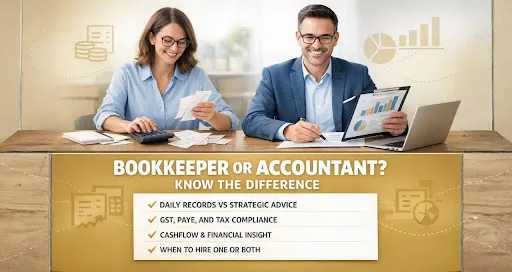
That’s when the big question arises: “Do I hire a bookkeeper, an accountant, or both?”

The answer isn’t simple, but getting it right can save you time, money, and sleepless nights. 

Let’s walk through the differences, explain when each is essential, and show a workflow that keeps your business compliant and confident.

Why Understanding the Difference Matters

Here’s the reality: bookkeeping and accounting are not the same thing. Mix them up, and you risk mistakes that can be expensive.

  • Filing GST or PAYE incorrectly
  • Missing deductions
  • Late submissions and penalties from the IRD
  • Cashflow headaches that could have been avoided

Think of it this way: bookkeeping keeps your finances organised, while accounting helps you make sense of those numbers. Both are important. Both work together, but for different purposes.

Bookkeeper vs Accountant NZ: Roles Explained

Sometimes it helps to see it side by side. Here’s what each role does in a NZ small business:

TaskBookkeeperAccountant
Record daily transactionsYes
Reconcile bank statementsYes
Track invoices & paymentsYes
Manage GST & payrollYes (Only draft)Yes (Final)
Prepare financial statementsYes (Only draft)Yes (Final)
Tax adviceYes 
Strategic financial planningYes
IRD compliance & lodgementYes
Business growth adviceYes
Bookkeeper vs accountant nz

Bookkeeping in NZ

Bookkeepers are like the front-line soldiers of your finances. They make sure every sale, invoice, and expense is recorded properly.

  • Enter sales, invoices, and expenses weekly
  • Reconcile bank statements monthly
  • Prepare GST drafts
  • Track cash flow to prevent surprises

Without accurate bookkeeping, your accountant will struggle to provide advice…and mistakes can slip through unnoticed.

Accounting in NZ

Accountants take the data your bookkeeper prepares and turn it into insight. They check for errors, ensure IRD compliance, and help you make strategic decisions.

  • Finalise financial statements for year-end reporting
  • Advice on deductions, provisional tax, and PAYE obligations
  • Submit accurate returns to the IRD
  • Guide your business growth and cash flow strategy

At Elite Accounting Limited- Chartered Accountants, we combine bookkeeping and accounting services so your finances are organised, compliant, and ready for growth.

When Your Business Legally Needs an Accountant

Some NZ businesses must involve an accountant. For example:

  • Companies or LTCs needing certified financial statements
  • Businesses with employees submitting PAYE and KiwiSaver
  • Businesses with turnover requiring provisional tax and GST
  • Situations with complex transactions, loans, or audits

Even if you’re a sole trader, there are times when an accountant becomes essential:

  • Filing annual tax returns correctly
  • Claiming deductions or managing IRD queries
  • Planning for business growth, financing, or investment

Decision Matrix: Who Does What?

Here’s a simple guide to help you decide:

ScenarioBookkeeper OnlyAccountant OnlyBoth
Sole trader, simple income & expensesYes
Sole trader, GST registered & employeesYesYes
Small company, multiple shareholdersYesYes
Growing SME, complex cashflowYes
Preparing for audit or IRD reviewYesYes

This matrix makes it easier to see who you need. Often, the best approach is both. Bookkeepers handle day-to-day records, accountants review, advise, and ensure compliance.

Difference between bookkeeper and accountant

Cost vs Risk: Making the Right Choice

Money matters. Hiring a professional may feel expensive. But consider the cost of mistakes.

  • Bookkeeper Only

Pros: Lower cost, keeps records tidy

Cons: Risk of missed deductions, incorrect GST or PAYE, cashflow errors

  • Accountant Only

Pros: Ensures compliance, provides strategic advice

Cons: Daily records may get messy, miand nor errors can slip through

  • Both Bookkeeper + Accountant

Pros: Smooth workflow, minimal mistakes, full IRD compliance

Cons: Slightly higher cost, but saves stress, penalties, and wasted time

At Elite Accounting Limited- Chartered Accountants, we help small businesses balance cost and risk. You get expert oversight without paying for unnecessary services.

How Bookkeeping Services NZ and Accountants Work Together

Here’s a workflow that actually works:

  • Daily/Weekly Bookkeeping: Record transactions, track cash flow, prepare GST drafts
  • Monthly Reconciliation: Bookkeeper checks records and flags issues
  • Accountant Review: Accountant ensures compliance, reviews GST, and advises on deductions
  • Quarterly & Annual Filing: Submit GST, PAYE, provisional tax, and annual returns on time
  • Strategic Advice: Accountant recommends tax savings, cashflow improvements, and growth planning

This workflow keeps your finances accurate, stress-free, and IRD-compliant.

Choosing the Right Partner for Your Business

Picking the right financial partner isn’t just about cost. Look for:

  • NZ Experience & IRD Knowledge: Understanding GST, PAYE, and compliance rules
  • Transparent Pricing: No hidden fees
  • Technology Compatibility: Works with Xero, MYOB, or your preferred software
  • Communication & Support: Explains numbers in plain English
  • Reputation & Referrals: Recommendations from other NZ small businesses

Elite Accounting Limited – Chartered Accountants provides practical, approachable support. We guide businesses through bookkeeping, accounting, and strategic advice so you can focus on what you do best: running your business.

FAQs

Can I manage bookkeeping myself?

Yes, for very small businesses. But errors can slip through, and accountants may struggle to provide advice. Professional oversight reduces stress and IRD risk.

Do I need an accountant if I hire a bookkeeper?

Often yes. GST, PAYE, tax returns, and deductions require oversight. Using both reduces errors and saves time.

What is the difference between a bookkeeper and an accountant?

Bookkeepers handle daily records. Accountants interpret data, advise on tax, and provide strategic guidance.

How do I choose an accountant in NZ?

Look for NZ experience, IRD knowledge, clear pricing, and strong communication. Ideally, they can work alongside your bookkeeper.

Are there penalties for mistakes?

Yes. IRD can charge fines or interest. Early bookkeeping and professional accounting prevent errors and reduce stress.

Conclusion: 

Here’s the bottom line: knowing whether you need a bookkeeper, an accountant, or both can save you time, money, and stress.

For NZ small business owners, combining bookkeeping with accounting ensures:

  • IRD compliance and peace of mind
  • Fewer errors and missed deadlines
  • Better financial insight for confident decision-making
  • More time to focus on growing your business

Elite Accounting Limited – Chartered Accountants helps NZ businesses manage both day-to-day bookkeeping and high-level accounting. We make finance simple, organised, and stress-free.

Speak with our specialist today to discuss your business needs and ensure compliance without the stress.

Written by Ronit · Categorized: Business Accounting · Tagged: accountant nz, Bookkeeper vs accountant nz, Difference between bookkeeper and accountant

Feb 24 2025

As an ambitious business owner, do you know which factors drive business success? They are growth, profitability and operation efficiency. Among the factors that make such success possible is tax and financial management. These two are the significant pillars that any business needs for its survival, without which even a promising venture might fail. This is where the importance of consulting an experienced tax accountant comes in. With all their experience, accountants manage not just the numbers but also guide businesses into making informed decisions.

Tax Accountant’s Role for Small and Medium-Sized Business

For SMEs operating in New Zealand’s intricate web of financial regulations and taxation, tax accountants are irreplaceable. They are beyond mere compliance; they are strategic advisors who help businesses streamline things and achieve stability. They ensure accurate preparation of financial statements and even leverage tax planning strategies that enable you to focus on growth and avoid any financial mishaps.

Tax Accountant's Role for Small and Medium-Sized Business

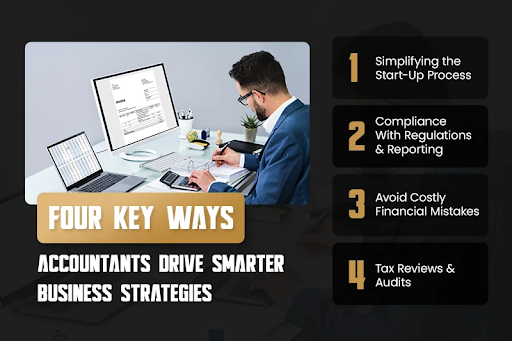
Here are four key ways accountants help business owners make better decisions:


1. Simplifying the Start-Up Process

Starting a business can be an overwhelming process. However, tax specialists make the whole process easier. They prepare and analyse monthly financial statements with extreme accuracy. This gives business owners a clear picture of their financial health. That, in turn, helps to make data-driven decisions. The ability to rely on up-to-date financial data allows for effective planning and strategic adjustments.

2. Compliance With Regulations and Reporting

Compliance with New Zealand regulatory requirements is also time-consuming but essential. Tax accountants in New Zealand help businesses maintain compliance by correctly preparing and lodging financial reports, tax returns, and other compliance documents. It minimises the risk of incurring penalties while keeping a good standing with regulatory authorities.

3. Avoid Costly Financial Mistakes
Bookkeeping or tax errors can be devastating, especially for SMEs and startups. Accountants identify potential risks, correct errors, and institute strong financial systems that ensure you do not repeat the same mistake. Their vigilance and expertise help your organisation with both time and money.

4. Tax Reviews and Audits

Tax reviews and audits must be periodic to identify discrepancies or missed opportunities in financial management. Tax professionals, on the other hand, conduct evaluations in detail that ensure compliance and help you to optimise tax returns. This way, businesses can reclaim funds they might have otherwise foregone.

The Final Thoughts

The work of tax accountants is not only about crunching numbers. They are your strategic partner to help your business achieve the growth and success it deserves.

If you are looking for superior accounting services in New Zealand, one name is trusted by all. It is that of Elite Accounting Limited – Chartered Accountants. Specialising in providing tax advisory for small and medium-sized businesses, our team of tax return accountants can help you with comprehensive year-end tax calculations with tailored accounting solutions. Whether you need a tax specialist or a small accountant for your business, we will assist you in every possible way to help you meet all your financial needs and achieve your goals. 

Browse our website or contact us now for a consultation!


Written by Elite Accounting · Categorized: blog · Tagged: accountant nz

May 12 2023

Understanding your company’s financial health is critical as it helps make intelligent business decisions. Unfortunately, accounting is not every entrepreneur’s top skill, and many fail to get into the nitty-gritty of their organisations’ financial records. 

The balance sheet and profit & loss statement are two vital financial reports that reflect a company’s financial health. Understanding what these reports convey means gaining a clear view of your company’s financial state. 

This post is crafted for people new to company accounting, where we will discuss the basics of the profit and loss statement and the balance sheet. Continue reading to expand your accounting knowledge and gain competence in business finance. 

Profit and Loss Statement

A profit & loss statement is widely known as a P&L account. People often refer to it as an income statement or statement of earnings. It provides a full breakdown of a company’s: 

  1. Revenue: Incoming money in the form of sales and other business income
  2. Expenditure: Payment made with cash or credit to buy goods or services

Close observation of the P&L will allow entrepreneurs to monitor revenues and expenses for a specific period. They can then look back over the period to check where they are making money and where they are losing it. Businesses can only be profitable if they make more and lose less money. P&L, in this context, can be used as a barometer to measure the profitability of a business. Every accountant in NZ and beyond recommend clients track P&L statement for:

  1. Getting a comprehensive breakdown of revenues and expenses
  2. Monitoring and summing up your profit and loss for a particular period

Balance Sheet

The balance sheet provides a snapshot of a company’s financial health based on the following accounting equation:

Equity = Assets – Liabilities

In the balance sheet of a company, you can check its:

  1. Assets: Possessions that a company owns, including cash and cash equivalents 
  2. Liabilities: Things that the company owes
  3. Equity: Funds invested by promoters and shareholders (if applicable) plus retained earnings

Keeping an eye on the balance sheet can be useful for:

  1. Measuring the financial position of the organisation
  2. Providing the net value of the tangible asset to potential buyers in case you are planning to sell up

Entrepreneurs can also use their balance sheets to prove their financial position to investors and lenders. 

We hope our discussion has helped you learn the fundamentals of company accounting. However, this is only basic, and the entire accounting process can be complex. Therefore, relying on an expert accountant in NZ or other countries is always recommended. Let experts manage your P&L, balance sheet, and other accounting aspects. Meanwhile, you can focus on your core operations. Elite Accounting Limited is an Auckland-based certified public accountant firm offering a full spectrum of services, including accounting and tax, bookkeeping and payroll, tax review and audit, audit and assurance, financial supervisory, advisory, etc. Contact us now to discuss your requirements. Let our team assist you with bespoke service and clear guidance to keep your business accounting organised and your tax preparation process effortless.

Written by Elite Accounting · Categorized: blog · Tagged: accountant new zealand, accountant nz

Contact Us

We would love to hear from you. Email, phone or connect with us via social media.

09 393 7025

0210 886 9295

info@eliteaccounting.co.nz

261 Morrin Road, St Johns, Auckland


Xero Gold Partner

Footer

2026 ©
Elite Accounting Limited | site by: barefoot web design